Thursday, March 31, 2011

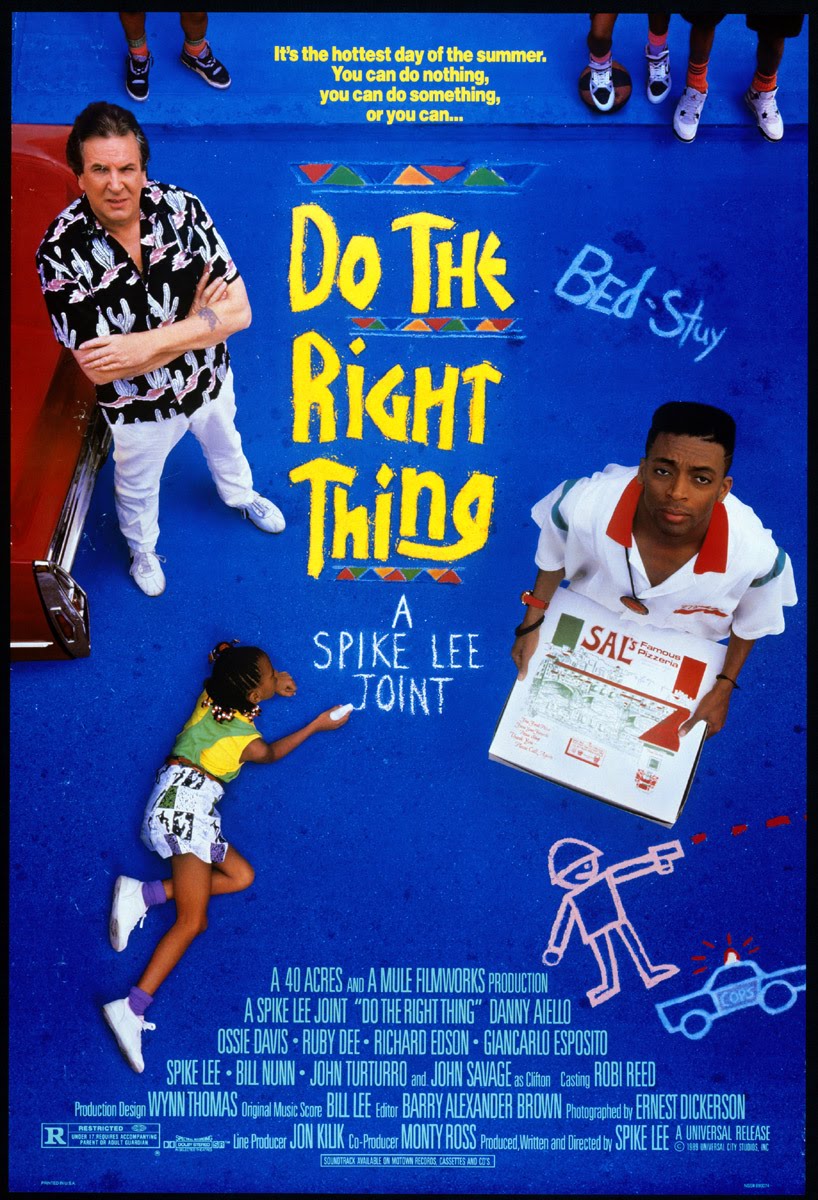
Do The Right Thing - Spike Lee

On a sweltering hot day in a Brooklyn neighborhood, Bedford-Stuyvesant aka "Bed-Stuy", everyone has their own issues to deal with and tensions between Blacks and Italians rise. Issues of pride and prejudice, justice and inequity come to the surface as hate and bigotry brings rise to bring to light the racial conflict in the multi-ethnic community.

"The film was released to protests from many reviewers, and it was openly stated in several newspapers that the film could incite black audiences to riot. No such riots occurred, and Lee criticized white reviewers for implying that black audiences were incapable of restraining themselves while watching a fictional motion picture.
One of many questions at the end of the film is whether Mookie 'does the right thing' when he throws the garbage can through the window, thus inciting the riot that destroys Sal's pizzeria. Critics have seen Mookie's action both as an action that saves Sal's life, by redirecting the crowd's anger away from Sal to his property, and as an "irresponsible encouragement to enact violence". The question is directly raised by the contradictory quotations that end the film, one advocating non-violence, the other advocating violent self-defense in response to oppression.
Spike Lee has remarked that he himself has only ever been asked by white viewers whether Mookie did the right thing; black viewers do not ask the question. Lee believes the key point is that Mookie was angry at the death of Radio Raheem, and that viewers who question the riot's justification are implicitly valuing white property over the life of a black man." - Wikipedia

The movie starts off with a Hispanic girl dancing to Public Enemy's song "Fight The Power" with boxing gloves. This is also the song that Radio Raheem loves to blast on his radio on the loudest possible volume. "Fight the Power" is not about fighting authority, it’s about fighting abuse of power. I felt like this was fitting because the police and white men abused their power in that neighborhood. I also felt like it was ironic that Radio Raheem was murdered by the police officer and he was the one always playing the song.

 "Elvis was a hero to most
But he never meant ---- to me you see
Straight up racist that sucker was
Simple and plain
Mother---- him and John Wayne
Cause I'm Black and I'm proud
I'm ready and hyped plus I'm amped
Most of my heroes don't appear on no stamps
Sample a look back you look and find
Nothing but rednecks for 400 years if you check
Don't worry be happy
Was a number one jam"


There were also a lot of references to two civil rights leaders (who both happened to be assassinated in their time); Martin Luther King Jr. (MLK) and Malcolm X.  The film ends with two quotations. The first, from MLK argues that violence is never justified under any circumstances. The second, from Malcolm X, argues that violence is not violence, but "intelligence" when it is self-defense. Critics say that it is unclear where Spike Lee stands in respect to these two but I feel as though he is perfectly in the middle. In the movie, he didn't use violence until he felt like he had to. And even then it was only until the end that he actually turned to violence when he threw the garbage can through Sal's window.


This movie also did not hesitate to call out the stereotypes that different races have about each other. They pull absolutely no punches and speaks the truth. It has African Amercans speaking about Italians and vice versa, Hispanics about Asians, etc. It leaves no stone unturned.

All Buggin' Out wanted was for some black faces to be up on the wall. Is that really too much to ask? Blacks were the one who supported his business. In the end, it really didn't have to come to what it came to. Radio Raheem would still be alive, Sal would still own his store, and everyone could be one big happy "family". It shows just how unnecessary violence is because what did they really accomplish? Nothing changed. But overall, this was a really good movie. I would definitely recommend it and watch it again. I can't believe it didn't get any recognition back then because even today it is such a moving movie.

Wednesday, March 23, 2011

Shaft...again.

Let me start off by saying that I disagree with you Professor! This movie was better than the original Shaft to me. I don't know if its because I'm a biased Samuel L. Jackson fan or because of the fact that it was more recent. I enjoyed this movie because it was hilarious with a lot of witty comments and very colorful characters (People's, pictured on the left, was my favorite). He took care of his people, looked sharp, and was no-nonsense in his white Gucci suits. The movie starter with the same theme song as the original Shaft, and I must admit just because of the montage of sex, guns, sirens, and police cars that I would not like this movie as much as I did. I was wrong of course. I also expected it to be the same plot but to my surprise it was much different. It wasn't so much a remake to me but a reinvention.


"Don't get me wrong: ''Shaft'' is no white-bashing fantasy. It's a mean and lively urban cross fire, with racial cracks ricocheting off each other like popcorn, and shoot-outs staged with such hair-raising finesse that they just about cleanse the air. The movie's neo-blaxploitation politics could be described as righteous indignation lite. Shaft, the black cop, knows that the (white) system is rigged to protect people like Wade, the son of a real estate magnate. And so he sets up an elaborate rattrap to catch him, only to find an extra rat or two inside." I agree with this statement by the EW review because I felt like it corresponded to current day racism, not the old racism. I felt like Wade (the obviously racist murderer) was favored because he was white. The system was corrupt because they set bail at easy amounts for the man to pay. I mean, the price of freedom is priceless but murder, the last time I checked at least, was completely against the law despite your feelings or skin color. Oh! And I absolutely loved it when Shaft threw his shield at the judge and hit the wall. In my opinion, it was a metaphor for nailing the judicial system to the wall but so much more dramatic.


The movie, despite when it was made, challenged a lot for me because Christian Bale was the bad guy, and a good one at that! I'm used to him being Batman and fighting crime not committing it. He was so convincing and devious in his plans that I actually felt scared of him for a while. I thought he would get his butt kicked in prison when that prisoner wanted his shoes (what was he going to do with them in prison anyway?) but I was proven wrong once again when he kicked his ass instead. It looked like he would do anything, murder again too. He had so many people on his side and it always looked like he would get his way. He seemed so powerful until his downfall. Ahhh!!! Sweet, sweet revenge.


Overall I'd have to recommend this movie to those that enjoy a good laugh as well as many gun fights. I don't think anyone could have done this part better than Samuel Jackson. He's so good at being bad ass I don't think anybody will ever be able to top it.

Thursday, March 10, 2011

"He's a bad mutha..." "Shut yo mouth!" "But I'm talkin' bout Shaft!"

Who is the man that would risk his neck
For his brother man?
Shaft, can you dig it?
They say this cat Shaft is a bad mother
Shut your mouth
But I'm talkin' 'bout Shaft
Then we can dig it...♫

Growing up my father always made Shaft jokes so this was nothing new to me. My family grew me up watching movies like Foxy Brown and Original Gangstas (covering my eyes at the fresh parts of course) but it was still something that brought us closer together. Despite me know what these movies are I never heard the term "Blaxploitation" before taking this class. Blaxploitation (or "blacksploitation") is a film genre that emerged in the United States circa 1971 when many exploitation films were made specifically (and perhaps exclusively) for an audience of urban black people; the word itself is a portmanteau of the words "black" and "exploitation," and was coined in the early 1970s by Los Angeles NAACP head (and ex-film publicist) Junius Griffin. Blaxploitation films were the first to feature soundtracks of funk and soul music. These films starred primarily black actors." - Wikipedia

review by Damian Cannon describes Shaft as "A rhythmically exciting Harlem detective story, Shaft pulsates with street-level vernacular and a deep sense of conviction. John Shaft (Richard Roundtree), a black private-eye with run-down corner office, lives up to his reputation as a tough operator. Garnering respect from both cops and hoods, Shaft stands bestride the black-white divide with ease" and I agree. Shaft is one no-nonsense man!

What I noticed was that racial themse are challenged a lot. Shaft is black while the bad guys are mostly white. These movies were made in a time where racism was still around and the roles were actually reversed (or so they seemed). The hose inthe rescuing scene was significant because that was what the policemen used to spray the black men with who would just be chillin" on the corner. They didn't really have to be doing anything wrong but once they congregated that created a problem for some reason.

The camera also did some great effects in this movie during the fight scenes. For example, in the first fight scene in Shaft's office, I felt like I was in the fight too the way the camera spiraled as the guy hit the floor. The fast cut also gave you a feeling as if you were right there cause it was also taken from their point of views. The movie started off with an establishing shot of the city and there was montage editing showing him investigating the kidnapping. Over the shoulder shots when he was talking to Bumpy, and many point of view shots.

The music was also bad ass! It just made you feel like he was the boss and honestly I was dancing to the song. I love that kind of music. The way he walks like he owns the street also makes it more clear the kind of person he is. Cool, calm, and collected...but only when not messed with! If I were cast as Shaft I would probably dance my way into the scene with that music, but he just walks and minds his own business doing his own thing.

There is no doubt in anyone's mind after this movie that Shaft is one bad mutha...yeah, I know. Shut my mouth! But you get the point! I can't wait to watch the latest Shaft because I've never seen it. And everybody knows Samuel L. Jacksonn would be the perfect modern day Shaft! So we'll see! :-)


Wednesday, March 2, 2011

Faat Kine!

The California Newreel calls Faat Kine the "everyday heroism of African women." "Sembene has said: "Africa's society and economy are held together today by women. But how can women have these responsibilities and yet be denied the same privileges as men?" and I agree that this movie shows how women do so much better than men but still are treated as objects to them. This movie challenges the dominant ideology because the women do the opposite of what they are supposed to do in the African culture. They speak up for themselves, they are loud and independent, the say what they want in and out of the bedroom as well, they are fine being by themselves and having those kind of relationships; which definitely is against the Muslim religion as well.

Faat Kine was a great movie! Although it was not the first African movie I've seen it was definitely the best one. It didn't focus primarily on the negative aspects, but also the positive. To me it seemed like the theme revolved around breaking stereotypes and surpassing peoples' expectations of what you will become in life. For example, Faat Kine refuses to be held down by the stigma of being an unwed mother and she climbs to success and wealth. It also shows the generation difference between the children and the elders which to me signifies progress and independence. A great exampleof colonialism and neo-colonialism.

Throughout the film, it becomes clear that traditional roles between males and females, parents and children, no longer apply. For example, Mammy describes herself as the "daughter" of her daughter, Faat Kine; Djib recalls he always thought of his mother as his sister and he denies that his father has any right to call him his son; Faat Kine's father disowns her for her indiscretion. It shows the contrast between Kine's days and her childrens' days. For example, Kine knows her daughter is no longer a virgin but from the flash backs we can see that her father would not tolerate that under his roof.

The only part I didn't like about this movie was the fact that the subtitles were white and sometimes hard to see. Other than that, this was a very good movie to me. It went against tradition and kept you guessing, apart from the fact that it was really funny. I related to this more than I thought I would because it shows the same familiar message that many people are aware of; progress and preserverance.

Thursday, February 24, 2011

Once Upon A Time In The West...Not your typical western!


"Once Upon the Time in the West," which opened yesterday at Loew's State 2 and at Loew's Orpheum, is the biggest, longest, most expensive Leone Western to date, and, in many ways, the most absurd." - The New York Times

This movie challenges the dominant idealogy for most Americans from that time because the inhumane killer in this movie is a white man, whereas, viewers were used to seeing Native Americans as inhumane and cruel, cold blooded killers. The roles in this movie play against the stereotypes that everyone at that time is used to. Another interesting spin is that Henry Fonda was the villain. He was known back then as the guy who always plays the hero, gentleman and righteous man.

Another thing that was dramatically different for me (and I'm sure for the viewers back then too) was that the villain actually got to sleep with the girl (I think her name was Jill). She wanted him (and I'm still confused because he was the one who killed her husband). Whereas, what I'm used to is that the good guy gets the girl. And even in the end, he still left her there without even as much as a hand shake. Why??? Fall in love and live happily ever after! Although she wasn't your typical "damsel in distress" I think Jill's role in this movie was wonderful. She showed a different side of women that most movies don't portay; the real side.

This film was long but really good. It had amazing close up shots, the sound effects and music was great and definitely added to the mood of the scene. For example, when the fly was on the guys mouth all I could hear was that annoying sound that the fly makes and I thought to myself "Just kill the stupid thing already". The music and sound effects got the viewer to feel like they were experiencing the same that and made it that much more relateable. The scenery was also beautiful as like any other western movie.

I enjoyed this movie because it masterfully challenged the typical western, as well as, the normal types of roles these actors played. You never knew what was coming next so it mastered the element of surprise and above all, it was action packed, as well as, humerous. And with these compliments coming from someone who doesn't like westerns, this is a definitely under the "must watch" list!

Wednesday, February 16, 2011

So...where the heck is Debbie??? "The Searchers"

Now I don't know much about western movies, this was my first one. For most of this movie I was trying to figure out what in the world was going on. Why they hated the Indians, and why the Indians even attacked their home in the first place. This movie to me showed some racism and was very old fashioned, for example, women mainly spoke once the man spoke to them and also, males were the hunters and fighter while women kept the house.

The Searchers, by John Ford, is considered to be a true American classic of Western film making. I agree that the Searchers is a hate-ridden quest of crusaders obsessed with revenge and hatred. Indians are portrayed negatively as blood thirsty animals in this. Despite the violence, there was beautiful scenery that made it realistic. The establishing shots on Monument Valley gave the viewer a really good glance at where they were and allowed us to experience it as if we were really there.

John Wayne plays a typical cowboy from what I've seen and understand about western movies. He's tough, rugged, and a pro at handling a gun. He's always moving, never settling in one place, which could explain why he doesn't have a family of his own. He becomes a hero on his relentless search to find his niece and even then he doesn't stay and settle down with the family. I think this is a way of portraying that he is a loner and does not conform to society's beliefs that everyone should settle down and take care of a family. It shows him as an individual and the camera angle shows us (the viewers) as the normal ones looking out from the inside. Even in the end he is still searching. For what? I guess we'll never know.

Although I'm not a fan of western movies this movie was somewhat enjoyable. It had its humerous parts (Martin by the fire) as well as, the down time in the movie (i.e. when the family was slaughtered). The only thing I didn't really like about the movie was that it portrayed Indians as evil and was slightly racist. They also could've made it a little interesting when they saved Debbie if Martin had fought Scar to save her. That could've built a lot of suspense. I felt like the women were very dramatic and the men were just rough. My favorite part about the movie was the beautiful scenes of the valley. Overall, it was a pretty good movie and if you enjoy westerns you'll most likely enjoy this one.

Wednesday, February 9, 2011

The Panama Deception

The Panama Deception is a documentary that investigates the case of the 1989 US invasion into Panama. The US was not motivated by the need to protect American soldiers, capture Noriega or restore democracy. It was to force Panama to be under the control of the US. I feel as though the director, Barbara Trent, wanted us to feel exactly what the people were feeling; anger and extreme sadness. Thus, I felt like she tried to push her views onto us. Throughout this movie I felt as though America was the enemy and tricked Panama into letting them in just to gain control, like it was all they wanted. Trent used testimonies of victims, actual footage, as well as, new reports and pictures to show us exactly what happened.

The voice of the narrator also created a sense of authenticity/credibility because it sounded as though the person was confident, stern and firmly believed what they were saying. It goes back into history showing how the US first got into Panama dealing with the Panama Canal and how they infiltrated the Panamanian government using scandals to get Noriega in. Trent portrays the US as this monster that grows angry because they are not getting their way. America is the villain. They use actual footage of Bush's speeches, as well as, footage of the war.

Overall Trent was very convincing in the documentary by trying to show America as the enemy. At the end of the movie I felt really disgusted with the country and also felt as though things could've been handled differently. I felt as though they were lying to the people (I guess hence the deception in the title of the documentary) and Trent evoked those emotions very well.

The New York Times review; The Panama Deception states that the documentary is full of witnesses, for example, official spokesmen, ordinary folk and politicians and I agree with them with they say that this give it a hometown point of view. Trents photos and excerpts on interviews clearly show which side of the argument she is on as this is a one sided documentary. She obviously believes that the invasion was a mistake and the the US was taking advantage of the trust of the people.